
Stickey Intervals
A fun app created by Laura Gabrielson that teaches students 1) the intervals on the keyboard 2) the intervals on the staff 3) how to connect those intervals on the staff to the keyboard.
All games feature the fuzzy stick men note team and the odd ghost!
Offers both 1 player and 2 player games.
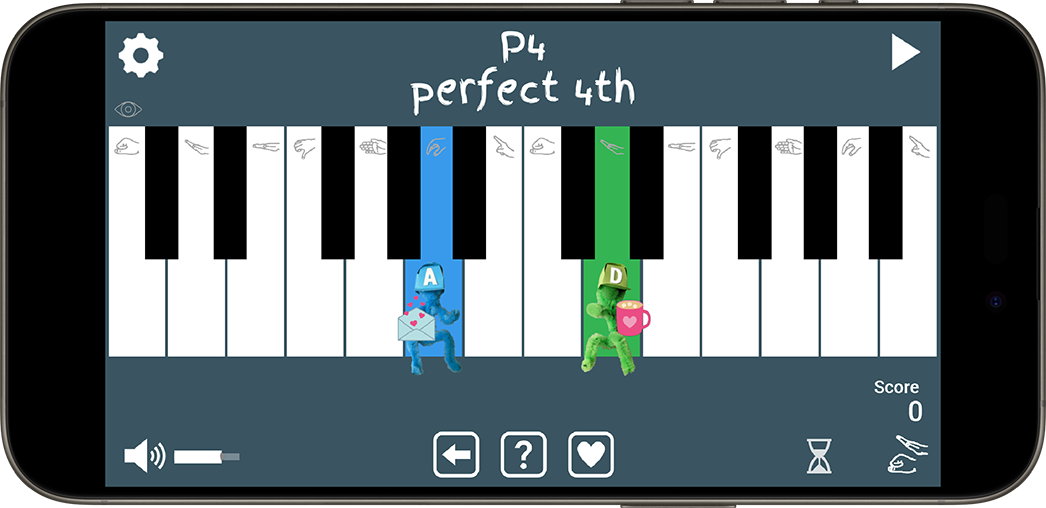
An enjoyable app that can help beginner students identify larger intervals such as 5th's and 6th's in just days
Level 1:
Drag the character to the correct piano key to form the interval...and don't let the ghost catch you!
Level 2:
Race to the top of the rope by selecting the correct interval. Who will get there first?!
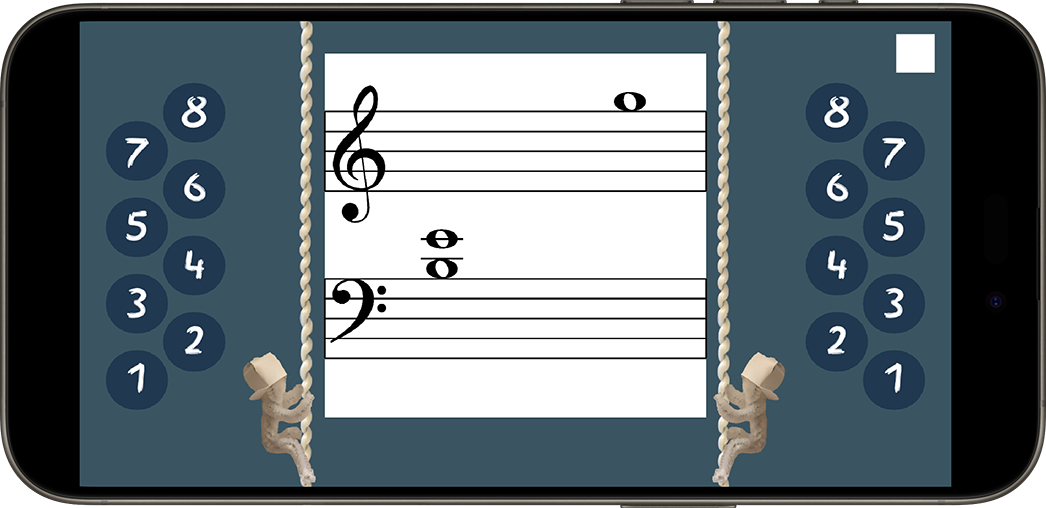
Level 3:
Drag the notes on the staff to form the intervals played while you listen to their sounds.
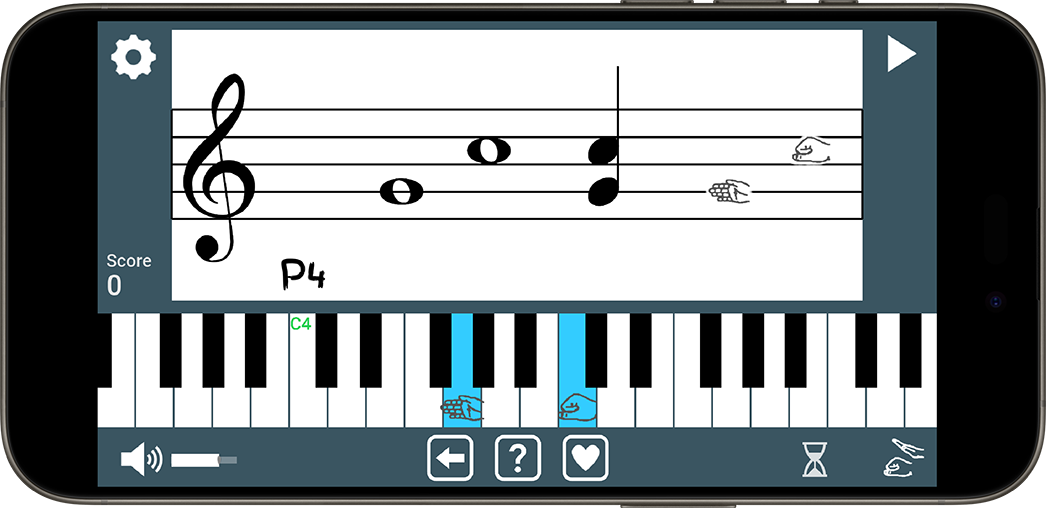
The two player games are especially fun. Students can compete against their teacher or against each other!
By learning intervals step by step, students quickly grow confident at spotting and playing bigger jumps between notes. This quickly fast-tracks their sight-reading progress.
Interview of creator Laura Gabrielson
After many years away from the piano, I rediscovered the joy of playing when my children started taking lessons. That inspired me to become a licensed Simply Music teacher in 2016, and I taught beginner students for the next 9 years, transitioning from Simply Music to other curricula along the way.
During this time, I developed the idea of a Note Team as a way to use sports analogies to explain music theory. The Note Team, with its seven fuzzy characters, became the foundation of many of my games and apps.
My son had been in piano lessons for a couple of years, but still had trouble with keyboard geography (he would guess a piano key if you told him to put finger 1 on G). I tried a few different ways to work on learning the note names of the piano keys, such as a physical card deck with instructions like "move up to the next A" and an interactive drag-and-drop computer activity for moving the letters to the correct keys. But these were boring.
So, with my background in computer programming, I decided to make a video game... and it was a great success! My son had fun and quickly learned his keyboard geography.
Reading music requires a combination of absolute and relative pitch recognition (ie. the notes and the intervals). If you only read music by converting each note on the staff to its absolute pitch (middle C, G4, D2, etc), you will never be able to read music fluently. That would be like needing to recognize each individual letter before you could read a sentence. In reality, we need to recognize patterns of notes in music to become fluent readers, and the most foundational pattern is an interval - or relative pitch distance - between 2 notes.
Adding a competitive component by making this a 2-player game transforms a flashcard-like activity, that might otherwise seem boring and tedious, into an enjoyable activity. Once students have success playing with smaller intervals, they are often eager to try again with larger intervals. Additionally, having the ability to customize the intervals before each game can help students differentiate between intervals that might look similar - just playing with 3rds and 5ths, then just 3rds, 5ths and 7th could help a student quickly recognize the difference between the odd intervals.
I also think the variability included in each game makes it more effective than flashcard set based games. In music, we encounter a mixture of harmonic and melodic intervals composed of various kinds of notes spanning a wide range of intervallic distances. Flashcards and Boom decks, on the other hand, are limited to a predetermined set of intervals (every game will have exactly the same cards shown, perhaps in a different order) and typically display the intervals in one way only (e.g., harmonic interval with 2 whole notes). In Stickey Intervals, each game is unique because the interval locations on the staff, the types of notes used in the intervals (sixteenth through whole notes), and the interval types (harmonic or melodic up/down) are all randomized.
With traditional flashcards, students can feel like they've mastered recognizing an interval, when in fact, they've just memorized a small set of representative intervals and will struggle when presented with an interval that looks different from the ones they have memorized. With Stickey Intervals, students are constantly being challenged to interpret new representations of the intervals, a skill they will need when reading a piece of music.
The first student I played Stickey Intervals with in a lesson exclaimed, "He threw a fish at him!" and burst into laughter as our first game ended. My own kids appreciated the slapstick humor, but it was nice to know that other children would enjoy it as well :). This student sometimes struggled with noticing unisons (he was in early pieces that just had unisons, 2nds and 3rds), so Stickey Intervals was a perfect way for him to practice this at home in a way that was enjoyable.
Stickey Notes
Six games for note recognition, with a single-player and a 2-player game for each of 3 levels.
Level 1: Characters are falling from the sky! Tap the key on the piano that matches the note letter name on the character's hat before the character falls off the screen. (Map note letter names to notes on the piano.)
Level 2: Notes are flying across the staff! Tap the character with the note letter name that matches in the note on the staff before it reaches the clef mark. (Map notes on the staff to note letter names.)
Level 3: Dodge the incorrect notes on the staff as you try to bump into the note that represents the piano key played. (Map notes on the piano to notes on the staff.)
Note Climb
Similar to Interval Climb, but for recognizing notes on the staff. Select the correct note letter name to move your climber up the rope.
Interval Climb
Just level 2 from Stickey Intervals for users who just prefer focussing on the intervals on the staff.
Stickey Chords
Given a chord name, create the chord on the piano by dragging the characters onto the keys. Change settings to select which type of chords you want to build. Use the arrows to go to the next chord.
Zigzag of Fifths
A linear representation of the circle of Fifths, the Zigzag of Fifths makes understanding key signatures easy. In Explore Note Teams, drag the window to reveal which notes are in every key signature. Display the keyboard to watch different notes become sharp and flat as you drag the window. In Explore Patterns, learn the underlying patterns of the Zigzag of Fifths.
Scale and SticKey
Scale and SticKey lets you explore key signatures and musical modes using relative do solfege. Drag the solfa wheel or the solfa slider on the piano keyboard to change between key signatures. Drag the characters to form your new Note Team, or select the '?' in the center of the wheel to have it revealed to you. Listen to different modes, scales and chord progressions by using the arrows and play button.
Caternome
An offbeat metronome alternative for duple and triple meter. Watch the caterpillar move as you change the tempo and beat subdivision.
Stickey Intervals complements Noteology really well.
With Noteology, students quickly learn to identify the notes from low C to high C on the staff and the piano. Stickey Intervals builds on this skill through games focused on learning the distances between notes (intervals) on the staff and piano.
Reading music is a combination of recognizing absolute pitches (the notes) and the intervals between pitches; both of these skills are developed when using Noteology and Stickey Intervals in combination.
My website has more info, including video demonstrations of the apps: www.stickeynotes.co